Saturday, August 15, 2015

Robert Anton Wilson & Operation Mindfuck / Ehkälogiikka [ robert anton wilson documentary "maybe logic" with finnish subs ]

http://disinfo.com/2013/08/robert-anton-wilson-operation-mindfuck/

Robert Anton Wilson & Operation Mindfuck

Picture: Richard Adams (CC)
[Disinfo ed.’s note: The following is an excerpt from Jesse Walker’s new book,The United States of Paranoia: A Conspiracy Theory. The excerpt is part of the chapter "Operation Mindfuck” and focuses on the role of the Discordian Pope, Robert Anton Wilson.]
[R[Robert Anton]ilson laid out the basic instructions for Operation Mindfuck in a memo sent to several friends (including [P[Paul]rassner). Participants were “to circulate all rumors contributed by other members,” and they were “to attribute all national calamities, assassinations or conspiracies to the other member-groups.” The one great risk, he cautioned, was that “the Establishment might be paranoid enough to believe some wild legend started by one of us and thereupon round up all of us for killing Abraham Lincoln.”
So they sent a letter on Bavarian Illuminati stationery to the Christian Anti-Communist Crusade, just to confirm that “we’ve taken over the Rock Music business. But you’re still so naïve. We took over the business in the 1800s. Beethoven was our first convert.” Robert Welch of the John Birch Society got a letter informing him that Gary Allen was an Illuminati agent. When a New Orleans jury refused to convict one of the men Jim Garrison blamed for the JFK killing, Garrison’s booster Art Kunkin of the leftist Los Angeles Free Press received a missive from the “Order of the Phoenix Angel” revealing that the jurors were all members of the Illuminati. The telltale sign, the letter explained, was that none of them had a left nipple.
The Discordians planted stories about the secret society in various leftist, libertarian, and hippie publications, introducing the Illuminati to the counterculture. “We accused everybody of being in the Illuminati,” Wilson recalled. “Nixon, Johnson, William Buckley, Jr., ourselves, Martian invaders, all the conspiracy buffs, everybody.” But they
did not regard this as a hoax or prank in the ordinary sense. We still considered it guerrilla ontology.
My personal attitude was that if the New Left wanted to live in the particular tunnel-reality of the hard-core paranoid, they had an absolute right to that neurological choice. I saw Discordianism as the Cosmic Giggle Factor, introducing so many alternative paranoias that everybody could pick a favorite, if they were inclined that way. I also hoped that some less gullible souls, overwhelmed by this embarrassment of riches, might see through the whole paranoia game and decide to mutate to a wider, funnier, more hopeful reality-map.
They inserted that chart into The East Village Other. They placed odd ads in Innovator. They practically took over the Chicago paper rogerSPARK, which once had been a fairly staid New Left outlet affiliated with the 49th Ward Citizens for Independent Political Action. The Discordians filled it with anarchist politics and surrealist satire: Someone scanning the classifieds might see an ad declaring, “paranoids unite; you have nothing to fear but each other! Send for the informative booklet ‘How to Start Your Own Conspiracy’. Free from the Office of the District Attorney, New Orleans.” In the summer of 1969, the paper accused Chicago’s mayor of being an arm of the octopus, running the front-page headline DALEY LINKED WITH ILLUMINATI.
In the April 1969 edition of the Playboy Advisor column, right after an inquiry about blue balls, this missive appeared:
I recently heard an old man of right-wing views—a friend of my grandparents’—assert that the current wave of assassinations in America is the work of a secret society called the Illuminati. He said that the Illuminati have existed throughout history, own the international banking cartels, have all been 32nd-degree Masons and were known to Ian Fleming, who portrayed them as SPECTRE in his James Bond books—for which the Illuminati did away with Mr. Fleming. At first, this all seemed like a paranoid delusion to me. Then I read in The New Yorker that Allan Chapman, one of Jim Garrison’s investigators in the New Orleans probe of the John Kennedy assassination, believes that the Illuminati really exist. The next step in my galloping descent into credulity occurred when I mentioned this subject to a friend who is majoring in Middle Eastern affairs. He told me the Illuminati were actually of Arabic origin and that their founder was the legendary “old man of the mountains,” who used marijuana to work up a murderous frenzy and who fought against both the Crusaders and the orthodox Moslems, adding that their present ruler is the Aga Khan; but, he said, it is now merely a harmless religious order known as Ismailianism.
I then began to wonder seriously about all this. I mentioned it to a friend from Berkeley. He immediately told me that there is a group on campus that calls itself the Illuminati and boasts that it secretly controls international finance and the mass media. Now (if Playboy isn’t part of the Illuminati conspiracy), can you tell me: Are the Illuminati part of the Masons? Is Aga Khan their leader? Do they really own all the banks and TV stations? And who have they killed lately?
The letter was signed “R.S., Kansas City, Missouri,” but it had actually been cooked up by Wilson and Thornley. Wilson’s reply, written in the light and neutral tone expected of the Playboy Advisor, cleared up most of the historical confusions contained in the letter (though it added the unsupported claim that Weishaupt’s Illuminati were “based loosely” on the Old Man of the Mountain’s order). The Berkeley Illuminati, Wilson added, were “a put-on by local anarchists.”
It wasn’t always easy to tell where Operation Mindfuck ended and sincere paranoia began. “The Discordian revelations seem to have pressed a magick button,” Wilson later wrote. “New exposés of the Illuminati began to appear everywhere, in journals ranging from the extreme Right to the ultra-Left. Some of this was definitely not coming from us Discordians.” Not that it was always clear who “us Discordians” were either. Though some of the Berkeley Illuminati were acquainted with Thornley, they had independently invented the joke of posing as an ancient conspiracy. At one point, Wilson recalled, the Los Angeles Free Press printed “a taped interview with a black phone-caller who claimed to represent the ‘Black Mass,’ an Afro-Discordian conspiracy we had never heard of. He took credit, on behalf of the Black Mass and the Discordians, for all the bombings elsewhere attributed to the Weather Underground.”
162px-Illuminatus1sted
Wilson and Thornley met only once in that period, when Wilson spent the night at Thornley’s place in Tampa in 1968. They smoked some pot and started ruminating about their project. “What if there really is an Illuminati?” Wilson asked. “Maybe they’ll find out about us and be pissed.”
“I doubt if there is,” Thornley replied. “And if there by some chance is, they would probably be very happy to have wildass fools like us covering up for them by spreading bizarre theories.”
paranoiaIn 1969, Wilson and another Playboy editor, Robert Shea, began to work on what would become the most influential element of Op eration Mindfuck. Inspired by the nutty letters the magazine often received, Shea and Wilson decided to write a novel “perched midway between satire and melodrama, and also delicately balancing between ‘proving’ the case for multiple conspiracies and undermining the ‘proof.’” The result was Illuminatus! It was basically finished in 1971 but it wouldn’t be published for another four years, with significant cuts and with the book sliced into three volumes.70 (A one-volume edition finally appeared in 1984.)
Excerpted from Jesse Walker’s new book, The United States of Paranoia: A Conspiracy Theory, by kind permission of the publisher, Harper Books. © 2013 Jesse Walker.

http://blog.kansanperinne.net/2011/09/ehkalogiikka-dokumentti-robert-anton.html

Thursday, August 6, 2015

The Truth According To Satan (1972)

The Truth According to Satan (1972)

To call Renato Polselli’s The Truth According to Satan a.k.a.La verità secondo satana a movie about a woman being framed and blackmailed for her lover’s murder just doesn’t really capture what it’s all about. Anyone familiar with Polselli’s work will know that there’s usually a lot more to it than that, with the story being more like groundwork for filmmaking experimentation and expressionism, not to mention some truly disorienting editing. One could say the satanic title is misleading, but taking a lot of the, what I’m assuming to be, elaborate metaphors, it’s possible to make an attempt to figure in a correlation between the title and the film’s events. It’s like a type of art that one could draw numerous interpretations from and yet still be quite off. 

A woman, Diana (Rita Calderoni, whose beautiful eyes still shine through in the fuzzy looking, low quality version I watched), seems to be at the core of a man’s, Roibert’s (Isarco Ravaioli), depressions. Sick of himself and going through what is no doubt an existential crises, he deeply contemplates and, in a melodramatic bout of playing Russian roulette with himself, fails at committing suicide, an insult which only seems to further his unease.

Calling up the lady of his sorrows, Diana, in the midst of a love affair with her female companion/slave, Yanita (Marie-Paule Bastin), Roibert informs her of his failed attempt at killing himself, threatening to try again. She hastily comes over to his place, looking nice and sexy, and Roibert eventually does stab and kill himself while leaning over her, smearing his blood over her. The neighbor, a strange jester of a man, Totoletto (Sergio Ammirata, chewing the scenery like none have ever done before), seems to have witnessed enough of the incident from the window to decide to have a fun time with the situation, turning the film into a deranged comedy from here on out.


Totoletto is a total clown, with a hefty amount of black humor that hits the spot at times. Unfortunately, his chicken sounds are a little too frequent and a little irritating. Though, it's still not enough to ruin the added dose of weird entertainment he brings to this already far-out, head trip of a, dare I say it, giallo.

The train of ideas that make up the story, of which Totoletto becomes in total control of, is frequently diverted by his highly eccentric diet of consuming two eggs every hour. His commitment to this diet is borderline insane, exclaiming it to be “a catastropheeee!!!!” to miss out on his egg break. To give you an idea of what kind of humor is taking place, when Diana attempts to turn the tables, threatening to frame Totoletto for the killing and kidnapping her, he freaks out, screams, and runs to the next room, worried about his eggs overcooking. I’m giggling just writing this; I love that guy!


As evidenced here and in some other works with Polselli, The Reincarnation of Isabel and Delirium, Calderoni has a talent for communicating a mental breakdown in front of the camera. The way she does it is excessive, which I like, and all the while the emotion seems genuine. 

In addition, I’m a bit drawn to a peculiar yet subtle recurring motif to the, obligatory to the sexploitation, tortures that Diana is put through, where a transition, going from discomfort to pleasure, is depicted in Calderoni’sexpressions. Segments including her mad boyfriend teasing her with the sharp tip of a blade over her body, or her being tied down while a dog eats raw meat off her body, or being sprayed over with a showerhead after being covered in blood, all end up with, somewhere in there, the actress going from a panic, or extreme distress, to what for sure appears to be approval and pleasure.


Giving a deep backstory to Diana and Roibert, dream-like flashbacks are used to suggest the emotions felt during their meeting for the first time and their time spent together. It's a love of very beautiful origins, giving a bittersweet reminder of the love’s gloomy end.

Battle stock footage is used to odd, disorienting effect, edited in to depict Roibert’s psych and the extent of the conflicting nature of his obsession with Diana, a woman who takes control of her relationships, including her female lover, Yanita, of whom she orders and whips like a slave. The two main male characters obsessively endeavor to turn this role of control around, taking pleasure in leading the game she usually takes charge of. In one instance, Totoletto has Yanita whip Diana instead, reversing the roles of master and slave. Diana seems to seduce Yanita back to her side with a soft kiss to the leg, much to Totoletto’s hilarious dismay.


After trying to make up its mind as to whether or not Diana’s plight is something supernatural, her going mad, or the result of someone keen on her torture, the movie finally wraps things up with a twist that isn’t really all that twisty. It even seems like Polselli thought it best to interrupt the climax a few times by cutting to a fabulous shot of dancing, naked hippies, with Yanita included, of which I always have a hard time resisting dancing to. I thought this might have been edited in from a different movie, like some kind of patchwork, but Totoletto’s interaction with these transcendental partiers at the end confirms that it is meant for this movie, and I’m glad for that.


Given all that I’ve discussed, I still can’t help saying that the only way to know what this movie is about is to see it. It starts out like a tame little suicide drama and eventually escalates into a party of the grandest, mind expanding, erratic surrealism. It’s what I was looking for with a Polsellifilm, yet it still ended up not being what I was expecting. And the scenes with the dancers are so damn brilliant! That’s what I want to see more of.


Wednesday, August 5, 2015

Powell Peralta - Propaganda (1990)

The Propaganda video featured Tony Hawk, Steve Caballero, Lance Mountain, Mike McGill, Ray Barbee, Ray Underhill, Paulo Diaz, Frankie Hill, Steve Saiz, Chet Thomas, Lori Rigsby, Salman Agah, Lance Conklin, Colin McKay, Bucky Lasek, Frank Hirata, Eric Sanderson, Sean Mortimer, Mike Manzoori and more.

Tuesday, July 28, 2015

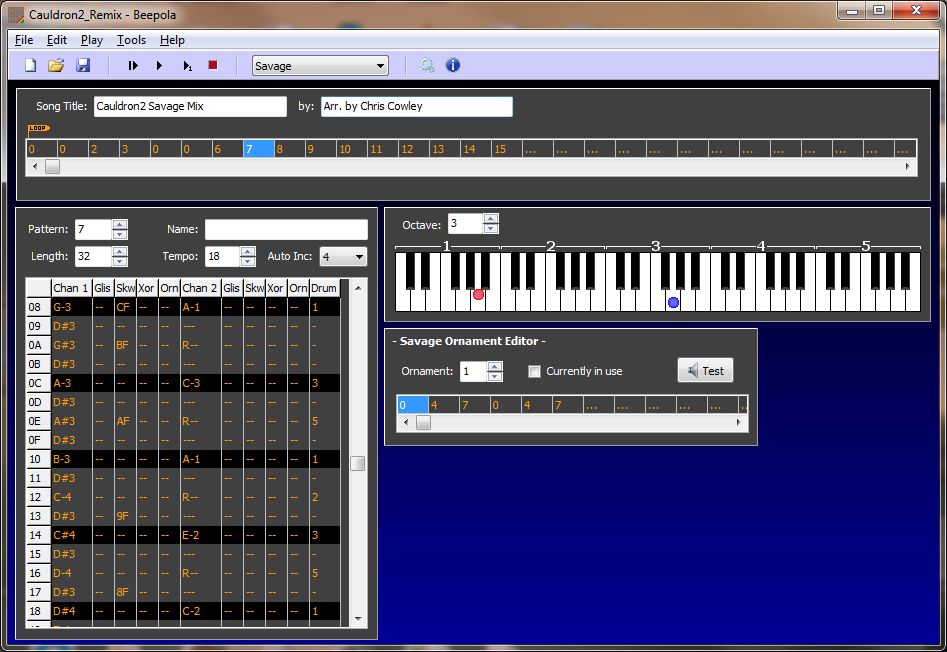
1-Bit Music

http://freestuff.grok.co.uk/beepola/

Screenshot (PNG, 117KiB)
Download Beepola v1.08.01 for Windows (1.76MB)
   (it also runs on MacOS and linux systems with WINE installed)
Beepola online help and documentation

Stay up to date on the latest 1-bit music news with the 1-bit music news blog:
1-bit music news blog
 Also, check out the 1-bit/beeper music forum at: http://1bit.i-demo.pl


http://www.oldskool.org/pc/MONOTONE

MONOTONE

The Tracker For Extremely Simple Sound Devices

UPDATE: All MONOTONE releases and updates are now hosted at github. Visit the github repository for MONOTONE.. This page will no longer be updated.
Download MONOTONE alpha 0.37b
Changes in 0.35:
  + Added Tandy/PCjr 3-voice support.  No volume or noise channel yet.
  * Got really tired of the sluggish pattern editor performance when
    trying to write a 4-track tune and spent another 6 hours converting
    string operations in the pattern repaint routine to highly-optimized
    assembler.  Navigating a pattern is now tolerable, although it's still
    not as snappy as if I weren't forced through some OOP inefficiency.
For older updates, check monotone.rev in the .zip file.

History: What is MONOTONE?

MONOTONE started as a bit of a joke between Necros and myself, where we were laughing about how nobody had created a tracker for the PC speaker. I like vintage PC challenges (see 8088 Corruption for another example), so I went about making one. MONOTONE's original design goals were:
  • Support the PC speaker, making a reasonable attempt to play multiple voices
  • Take only a tiny bit of CPU time to play the music (ie. should be able to play in the background without affecting the machine)
  • Run on any machine (ie. 128KB PC or PCjr)
As development continued, I decided to use the opportunity to finally see what all of the fuss was about with Object Oriented Programming (OOP) and designed MONOTONE as my first OOP exercise. This increased development time greatly (it took me three months of free time to complete, which is a heck of a lot of time for such a simple program), but had the benefit that song data handling, output device handling, screen handling, and the player engine are all objects. This allows descendants of each object to only need a few routines to support a completely new screen/file format/output device. (This decision has turned out to be fruitful, as people have already ported MONOTONE's engine to other devices; see External Links below.)
A very basic version of MONOTONE that met these goals was entered into Block Party 2008's Wild Competition and happily won 2nd place. Here is a short video of me demonstrating MONOTONE as part of the competition.
MONOTONE development is ongoing, but already it's quite a useful little program, so you are encouraged to download it and try it out. Full source code is included, so you can alter MONOTONE to your needs.
The documentation in the .zip file contains more information than this web page, so feel free to grab it and take a look.
TrackMan068 provides yet another example of what is possible in MONOTONE's limited capacity:

Roadmap

The full roadmap is in the manual, but here's the quick rundown on the development milestones:
Version 1 is finished and has 8 protracker-compatible effects; supports PC speaker, Adlib, and Tandy/PCjr; it runs on any 128KB or greater PC with a color monitor. Half the editor functions are still missing, but those are on hold for version 2:
Version 2 will add support for up to 12 tracks; will switch to ST3 effects/notation and editor commands; volume control; generic "instruments" with ADSR envelopes, arpeggio control, but also extensions for chip-specific stuff like noise channel control; more sound devices such as true multi-squarewave PC speaker output, the CMS/Game Blaster, and the Bank Street Music Writer card; more powerful and flexible editor features; support monochrome screens and 80-column mode (needed for additional track display).
Version 3 -- no idea. I've thought of full OPL2/OPL3 manipulation, but there are so many other FM trackers out there that I think it would be pointless to try to become YET another adlib tracker.

Contact Info

If you'd like to follow MONOTONE development, suggest improvements, request features, etc. feel free to join the MONOTONE mailing list.

External Links

Sprite_TM ported the MONOTONE playback engine to the AVR! (specifically, an ATTiny84) Here's a video of it in action. He also figured out a low-cost way to decrease the size of the file format, which I will document in the manual when I get a chance.
Need to record the output of the PC speaker?
Feel free to show MONOTONE some love on pouet.


Monday, July 27, 2015

Crappy Skateboards / Starter Skate

http://skateandannoy.com/blog/2015/06/starter-skate/

starter-skate
This is a curious product. I imagine it came into being via a discussion about the quickest way to cash in on a fad while spending the least amount of money. They must have thought the very clean design and sharp top graphic would fool an unsuspecting customer into thinking this was an actual skateboard, and if you glance at it sideways and squint your eyes, it look s good. The strangest thing is that the Starter Skate allegedly comes out of England in the 70’s. We’re talking England in the 70s, not Soviet Russia in the 60’s. I asked Neil about it, he said he’d never seen one before. The UK had much better crappy skateboard technology, so this one is puzzling. I’ve seen boards with fixed wheels passed off as skateboards before, but never with such presentation. This one sold for about $50, and the fact that anyone bought it at all is no doubt in large part due to the very nice pictures the seller provided. This looks like a prop from a Back to the Future movie if McFly traveled to Nazi Germany.
starter1
starter2
starter3
starter4
starter5
starter6